
CAT
Career Aspiration Test
Explore
Designed for students who are beginning to think about academic direction, subjects, streams and possible career pathways.
Career direction
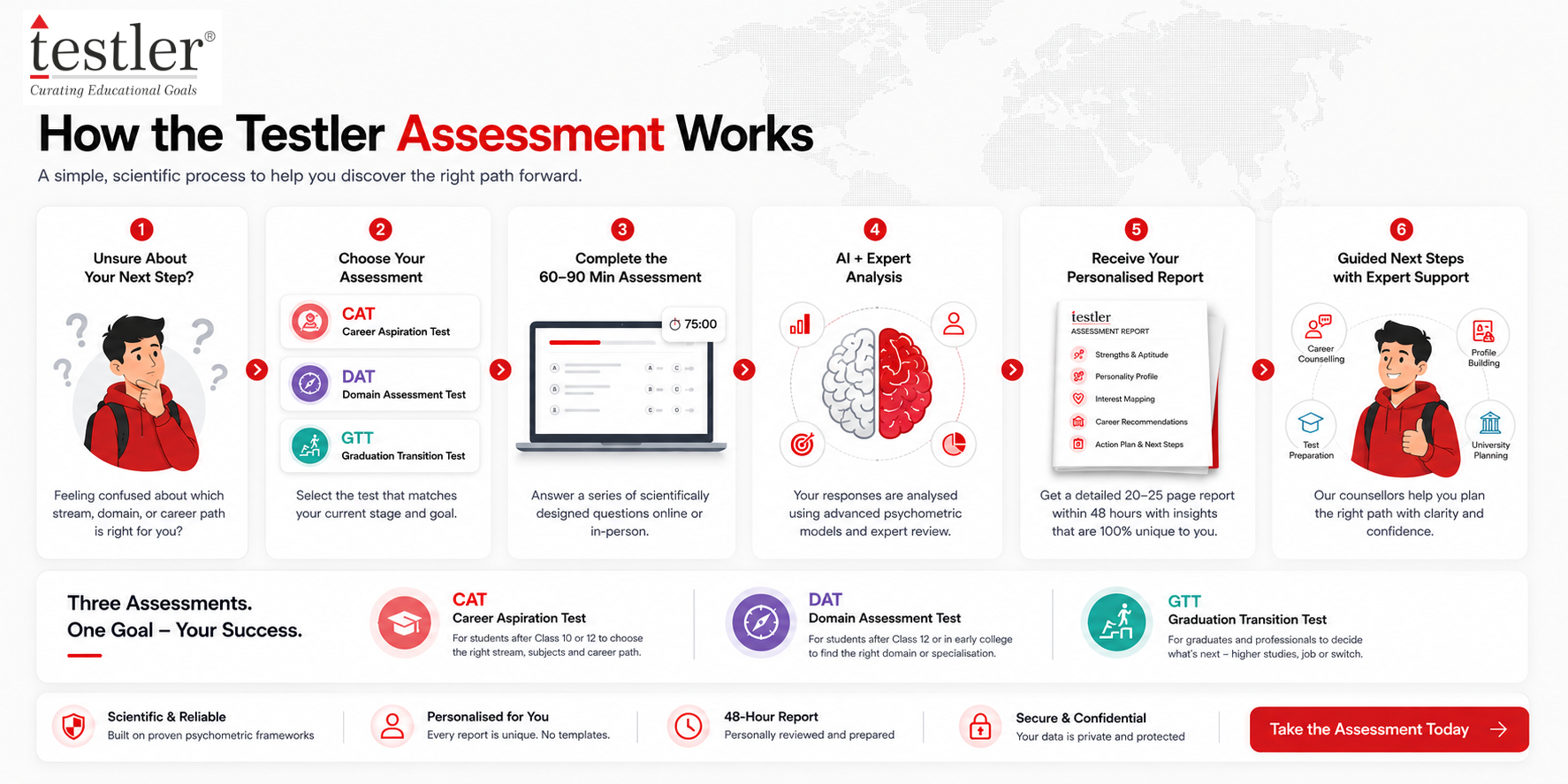
Testler's aptitude assessments help students understand themselves better at important academic and career decision points, using structured assessment as a starting point for more informed conversations and choices.
CAT, DAT and GTT are designed around different decision points, from exploring direction to making academic choices and navigating the transition beyond graduation.
The assessment becomes useful when its findings are brought together in a structured report that can support the next conversation.
Sample report shown with hypothetical student information for illustration purposes.
Choosing a stream, domain, higher-study pathway or career direction can feel difficult when students are working with incomplete information about themselves.
An aptitude assessment provides structured information that can become part of that decision-making process.
At Testler, the assessment is not treated as a final answer. It becomes a starting point for interpretation, discussion and further exploration.
The right assessment depends on where the student is in their academic or professional journey.
Designed for students who are beginning to think about academic direction, subjects, streams and possible career pathways.
Designed for students who are moving towards decisions about domains, areas of study, specialisations and possible pathways.
Designed for graduates considering what comes next, including higher studies, employment, upskilling or a change in direction.
The assessment creates a structured basis for understanding the student's direction at a particular stage.
The findings become more useful when considered alongside the student's academic background, interests, goals and circumstances.
The real value comes from understanding what the findings mean for the individual student and what should happen next.
The student completes the assessment appropriate to their stage and decision-making needs.
The findings are reviewed to identify the patterns and insights that are relevant to the student's situation.
The assessment is placed alongside the student's own perspective, academic context and aspirations.
Relevant academic, domain or career possibilities can then be explored with greater context.
The findings can contribute to practical next steps rather than remaining as a standalone assessment report.
That is why Testler uses different assessments for different decision points.
Students beginning to think seriously about subjects, streams, fields and possible career directions.
Students approaching important decisions about what to study and which directions to investigate further.
Students thinking about specialisation, further study or how their interests connect with possible domains.
Graduates considering higher studies, employment, upskilling or a change in professional direction.
Individuals evaluating a change and looking for a structured starting point for the next decision.
Parents looking for a structured way to support an important academic or career decision without making the decision for the student.
The result is one important piece of information within a much broader process.
No assessment can reduce a student's future to one predetermined career.
Assessment provides information. Counselling brings that information into the student's wider context.
Academic and career decisions evolve as students gain experience, information and exposure.
Testler can connect assessment findings with wider counselling, academic planning, testing and profile development, depending on what the student actually needs.
The right assessment depends on the decision the student is trying to make.
If you are unsure which assessment is appropriate, begin with a conversation about where the student is now and what decision comes next.